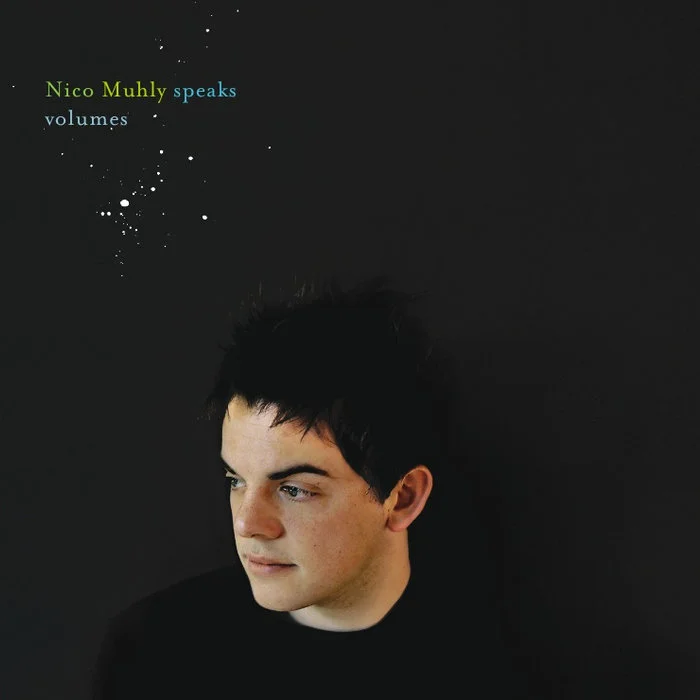
Notes by Daniel Johnson:
Nico’s generation was born after the premieres of Reich’s Music for 18 Musicians and Glass’s Music in Twelve Parts. These are pieces that present themselves as purely intellectual exercises, controlled by arithmetical processes rather than emotional narrative, and relying on traditional, “tonal” harmonies and gestures only to provide a greater transparency into their construction. But they are nevertheless remarkably affecting. Whether for cultural, psychological or even physiological reasons, harmony that moves from one triad to another, or merely from a state of dissonance to a state of consonance, is going to resonate emotionally with its listeners.
This record doesn’t sound like most classical records, where the idea is to synthesize an idealized version of live musical perfomance; the disc is a longer-lived and subtly groomed substitute for this authentic experience. Even a wildly innovative classical composer will usually produce a recording intended to conform in key respects to the nineteenth-century experience of classical music. This record was approached from a different direction. Almost all of it could be and will be performed live – Clear Music and Keep in Touch have both reached the concert stage – but live performance isn’t necessarily the ideal context for these pieces any more or less than your stereo at home.
Of course, even terms like “producer,” “engineer” and “programmer” understate Valgeir’s role in a collaboration such as this one. Valgeir’s contribution here is not only technical but creative: in his unorthodox handling of ambience and balance on this album, he’s as much an interpreter of the music as the conductor would be on a conventional orchestral recording; in his sensitive digital realization of the electronic noises in this music, he is as much a performer as any of the other instrumentalists. In this respect, his role is less like that of a traditional classical producer than it is like that of the post-Sgt. Pepper rock producer. For one thing, the instruments are miked “too” closely, letting the listener in on the sort of nitty-gritty lips-on-mouthpiece, bow-on-string mechanics of musical performance that are usually washed away by concert-hall acoustics. Valgeir’s recording and production don’t sit back and let the music sweep the listener away, emotionally; it leans forward in exacting scrutiny and urges the listener to pay attention as well.
This is an especially arresting choice given that the music is composed using a highly expressive vocabulary. What’s being scrutinized, then, but expression itself? “Speaks Volumes,” “It Goes Without Saying,” “Keep in Touch,” “Honest Music”; most of the titles on this album describe an attempt to communicate. The title “Clear Music” could describe the transparency of its musical texture (a texture inspired, appropriately enough, by a Björk album Valgeir recorded), but it could also refer to the insistency with which its musical ideas are put forward. It attempts to “make itself clear.” Likewise, “Quiet Music” doesn’t necessarily describe the sound of the piece – if you’re listening to this record at a high volume, you might even find the entry of the melody a little jarring – but it does describe, among other things, the succinctness and discretion with which it communicates.
No composer can escape the sentimental implications of a musical device; no pianist can escape the physicality of his or her musical performance – an arpeggio up the ivories is going to tickle them no matter what. In fact, the lack of adornment over one of these constructions, in suggesting a reticence towards self-expression, is itself highly expressive. In the hands of someone willing to manipulate these things, the flattest surface, the merest gesture, even the deepest silence speaks volumes.
Clear Music begins with what is instantly recognizable as an expressive texture: an unaccompanied solo in the high register of the cello. The contour of the line is borrowed, like most of Nico’s vocabulary of sentimental gestures, from the English choral repertoire – particularly the choral music of the English Renaissance, where the smooth, white-key voice-leading occasionally indulges in chromatic dissonances and ambiguities impermissible in later, tonal counterpoint. The opening statement of Clear Music outlines a diminished fourth, generating its tension by the introduction of a chromatic tone into a modal melody.
When the celeste enters, it’s with another, clearly recognizable sentimental gesture – a leap in the upwards, followed by the sighing resolution of a suspension. But at this point the dialectic of the piece gets into gear, as this figure immediately restates itself with a clockwork obsessiveness, opposing the lyricism of the cello with the eighth-note pulse that quietly but almost unrelentingly dominates the piece.
Nico has variously identified two very different musical sources as the inspiration behind Clear Music: the motet Mater Christi Sanctissima by John Taverner, in which the treble line hangs in precarious isolation miles above the other voices, and Björk’s Vespertine, in which the singer’s half-whispered vocals unfold like a Miles Davis solo over the music-box plinks of harp, celeste, and an actual music-box. In both cases, the aesthetic is one of total exposure and nakedness, and Nico exploits its awkwardness to suggest a skepticism towards the very project of emotional expression in music. Ultimately, when the ensemble rushes to a too-easy, too-satisfying conclusion, a lengthy coda apologizes for and calls into question everything that’s come before it.

Here again, in It Goes Without Saying organism vs. mechanism. Valgeir’s electronics are “organic” in two senses of the word: first, for all their precision, they’re still designed to sound like the noises of something alive much more than they sound like music made with machines; second, they seem to share a certain sonic DNA with the other instruments in the piece. While there are chillier, metallic noises on the palette – samples ranging from a unique set of tiny bells to an ordinary kitchen whisk – most prominent are the woody clicks sampled from the keys of the clarinet and the pedals of the harmonium – the “silent” mechanisms usually concealed beneath the music.
The piece develops according to these same, dual organic principles. Among the acoustic instruments, the harmonium wheezes, and the clarinets beep and tootle, with a woody, pneumatic corporeality, so that the timbre is both entirely human and entirely of a piece. From the initial drone, the clarinets and electronics enter furtively, building the material of the piece from small, replicating cells into a lively and elaborate texture.
The minutely wrought surface is stretched over the simplest possible formal contour, the drone undergirding the piece progressing from C to F and back again. The second section begins when the harmonium collapses under its own sweaty dissonances, and the harmonic crisis precipitates a timbral one: a shocking burst of industrial noise, dominating rather than complementing its acoustic surroundings; the cello gives an icy, ominous tremolo on that low F. Finally, when the machine noises die away and we return to the tonal center, the mellow, woody clicking returns, and the gentle chiming of the celeste lets the clarinets know that they’re free once more to gambol in the sunny and spacious key of C.
Honest Music is a studio beast, never intended specifically for the concert stage. On the page, the violin part recalls something like Terry Riley’s In C, insofar as it’s a collection of discrete, modular phrases to be recombined in “performance,” or in this case, by the electronic manipulation of the recording--but these aren’t Riley’s musical Lego blocks; most of these are long, expressive, idiomatic gestures, combining Nico’s soaring English-choirboy diatonicism with Romantic, violinistic leaps and slides up and down the fingerboard. As these figures pile on top of each other, the close-miked, aberrant fiddle timbre comes to seem, as per the title of the piece, brutally candid. The other fragments, imitated in character by the sputtering harp and percussion of the accompaniment, sound more like scraps swept from a cutting-room floor somewhere--all false starts, warm-ups and afterbeats--and the glitchy, staticky noises in the background contribute to the sense of something rough, half-finished.
The result is to suggest that all of Honest Music is an out-take, a rehearsal for another, wholly imaginary piece. But the gravity and authority of Lisa’s performance, and especially of the harmonies (those low drones!) lend this an authentic drama in its own right: the sad beauty of things coming together and things falling apart.

“Quiet” in parts, in terms of sound – sometimes so hushed you can hear the pedals working on the piano – but only to create a musical chiaroscuro, some points left in shadow while others are brought brilliantly to the fore. And while the music is discreet, even minimal, here’s a third interpretation of the title: it refers to the attitude of emotional quiescence the piece evokes, as in the presence of a monument. It describes stillness. The melody moves slowly, but when it moves, it spans octaves, rising like a giant architecture above the low, cycling chords in the background.
At least half the time, Nico’s music is secretly sacred, and Quiet Music’s cathedral tunes are no exception. Over the low, austere chorale, that melody has the heft of iron bells, tintinnabulant in a style that nods to Arvo Pärt. Nico says this piece is “water music,” meaning a waste expanse of sea--as opposed to the rushing currents of A Hudson Cycle – but you might be forgiven if these great planes of sound instead remind you of he Great Plains. The ghost of Aaron Copland is hanging around here, too, in those wide-open harmonies (denser, warmer, less medievalist than Pärt’s), and in that desolate fanfare.
Whether landscape or seascape, the picture is the same: a deep and endless vista, a straight horizon-line. In this case, the horizontal is the long strand of A-naturals, rippling at the middle range of the piece, that gently but insistently links each section to the next. When it brings us to the coda, the sense we get is less of an ending than of a prelude to something else, as if our gaze has finally wandered upward from the horizon to fix on the sky.
A Hudson Cycle was written as a wedding gift for two friends, one of whom was leaving Manhattan behind to effect their union. This is music of longing and anticipation; losing a beautiful place, approaching a beloved person. The right hand and the left struggle to synchronize, now succeeding, now failing to coincide. The primary rhythmic figure--a restless polyrhythm of two beats in the right hand for every three in the left--should recall the onward rush of the titular river, which very much represents “home” for the composer. (There it is, out his window.) It should also recall the music of Philip Glass, one of Nico’s most important influences, who’s made extended two-against-three one of his compositional trademarks.
Regardless of complexity, scale, or ambition, music that uses a constant pulse, limited pitch materials, and gradually developing, repetitive structures is usually tagged as “minimalist.” Musical “minimalism,” of which composers like Glass have been accused, is an inherently erotic language, mimicking physical love both in the often frenzied repetition of its outward gestures and in the titillating slowness of its progress, and with that in mind we might also consider the possibility that, as befits the occasion, the friction between the two rhythms suggests the friction between two human beings. Of course, while Glass is famous for the neoclassical cool of his recent music, which often unspools itself in smooth, seamless quantities, this piece is more interested in the bumps and hiccups with which a minimalist score develops. It’s unsettled – hot – all seam.
Still, its relentless rhythms propels the piece as a river of sound, dark and liquid, especially as Valgeir’s mixed it here. Compare the tone of this piano to the keener, more metallic texture of Quiet Music; A Hudson Cycle is at once smoother and more intense, restless, sensual and driven.
A love duet, let’s say, for viola and tape. But the title, Keep in Touch – these are words of parting; it’s a long-distance romance at best, the taped vocals and the viola not so much keeping each other company as mirroring each other’s isolation.
Nico explains that he intended the piece to be the exploration of an awkward “in-betweenness” shared by Antony’s voice and that of the viola, and every dimension of Keep in Touch emphasizes the strangeness of these two androgynous instruments. The viola is uncomfortably close, opening the piece with the first in a series of cadenzas – classical solos in a pseudo-improvisatory style – composed and recorded in such a way as to emphasize the instrument’s inconsistencies of tone. (Valgeir concocted the inner-ear scrapings of the percussion track from samples of pretermusical viola noise.) Antony’s vocals, so stately on his own records, are reduced to abrupt, extemporaneous gestures, mutilated by the electronic environment. To widen the gulf between the two soloists, Nico gave each of them as little exposure to the other’s performance as possible: Antony hadn’t heard the viola part when he laid down the vocals, and not until the last moment did Nadia rehearse with Antony’s half of the piece.
Formally, at least, the piece might seem designed to offer some measure of consolation. The chaconne (a classical piece built around a cyclical chord progression) is a traditional form for music of lamentation, maybe because of the sad reassurance in the return of familiar harmonies. But there’s something less than reassuring about this chaconne – the harmonic cycle takes a wrong turn somewhere, churning out some ferocious dissonances; consolation is thwarted, and the music, after a climax of thunderous trombone and percussion blasts, gradually dwindles to a single, lonely note from the viola.
CREDITS
Composed by Nico Muhly
Produced and Mixed by Valgeir Sigurðsson
Clear Music
Clarice Jensen, cello
Nico, celeste
Monika Abendroth, harp
Cello recorded by Dan Bora
It Goes Without Saying
Carol McGonnell, clarinets
Hildur Ingveldardóttir Guðnadóttir, cello
Nico, harmonium & celeste
Honest Music
Lisa Liu, violin
Nico, harmonium & wurlitzer
Monika Abendroth, Harp
Quiet Music
Nico, piano
Pillaging Music
Samuel Z. Solomon, percussion
Nico, piano & celeste
A Hudson Cycle
Nico, piano
Keep in Touch
Nadia Sirota, viola
Antony, vocals
Kyle Covington, trombones
Viola recorded by Valgeir
Vocals & trombone recorded by Dan Bora
All programming and recording by Valgeir Sigurðsson and Nico Muhly unless otherwise indicated.
Valgeir & Nico
©2006 Bedroom Community