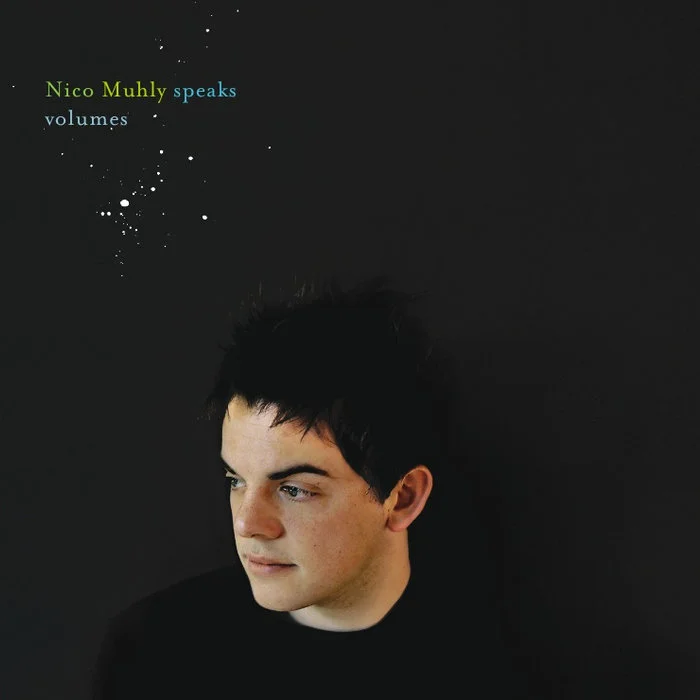
Nico Muhly - Speaks Volumes
Speaks Volumes marks the first release on Bedroom Community and features seven exquisite works of chamber music for small ensembles with electronics. This debut album by composer Nico Muhly was created with with Valgeir Sigurðsson in Reykjavik, Iceland and in New York, Nico’s hometown.
Since graduating from the Juilliard School for composition in 2004 Nico Muhly has been causing significant ripples in modern music circles with a variety of projects.
Press Quotes:
“The combination of Muhly’s formidable modern classical chamber compositions and Valgeir Sigurðsson’s greatly textured and varied production makes for some pretty remarkable listening.... If you’re after one of those records no one’s heard off but that everyone will want to own once given an airing - this is the real deal. Gorgeous.”
- Boomkat
"Some people are getting rather over-excited about Nico Muhly. They are right to do so."
- The Wire
“The first recording by a young composer on the rise blends ancient modes and contemporary gear to timeless ends.”
- Time Out New York
“Muhly’s range is expansive, the relationship between the emotional seriousness of his music and its boundless sense of humor is complex and rewarding”
-Fader Magazine
“a highly evocative and beautiful album...”
- Vital Weekly
“This is a dazzling album...a brilliant stylistic uniqueness.”
- Touching Extremes
"the sound of a future in which aesthetic worlds mingle and merge." "This is how something old and dead becomes exuberantly lurid and new." "an enthusiast's compositional strategy: I like it, therefore it's mine." -Newsday
"small, elegant parcels filled with clear melodies, pulsating rhythms and the occasional alarming abrasion" "[he has] a capacity to express emotion through circumspect means." -New York Times
"It makes a change to come across an album of contemporary music that's not merely a document of a "performance" but a piece of creative recording in it's own right". -Paris Transatlantic Magazine
REVIEWS / PRESS
from THE WIRE, July 2007
Nico Muhly - SPEAKS VOLUMES
When trying to capture what it is that ails much modern classical music, several words and phrases slither to mind. Bland, postmodern, minimal to the point of barely adequate, borderline Ambient, complacently sepulchral, supine, confused as to whether the place it lies in right now is a museum or a mortuary. Vermont born Juilliard graduate Nico Muhly, however, represents an honourable exception to all these charges. He has previously worked with Philip Glass but, thankfully, lacks Glass's 'glassier' tendencies. Speaks Volumes, a collection of chamber works for small ensembles with electronics, points the way ahead in several directions.
Titles such as Clear Music and Honest Music suggest an eagerness for transparency and connection, a theme that runs through this collection. But Muhly isn't merely recoiling into a 'simpler' trad-classical mode in order to reach a mainstream audience. Rather, he is constantly probing and surprisingly engaging. Clear Music's flurries of strings sporadically break ranks with protocol, rising against plucking harp strings that are at once buoyant and limpid. It Goes Without Saying, whose unconventional use of knocking rhythms recalls Mauricio Kagel, suggests a composer with grasp of both interiors and exteriors, making a music that is invaded and informed by both it's own history and the context of the present day, rather than defeated by them.
Daniel Johnson's exhaustive sleevenotes are a valuable asset; his positing that when Muhly's titles a piece Quiet Music, he is talking about the state of "quiescence", a revering awe, rather than the mere absence of noise. At just 25, Muhly is perhaps a little short of inspiring that sort of awe himself - right now he's working out new methods, establishing a voice, albeit doing a formidable job of it. All the same, Keep In Touch, a tentative and delicately poised exchange between strings and the electronically treated, taped vocals of Antony Hegarthy of Antony and the Johnsons, not only demonstrates a great emotional subtlety but raises questions of collaboration in classical music, with it's solemn fixation on sole authorship. The role of producer/electronics whiz Valgeir Sigurdsson, sometime producer of Björk and Bonnie 'Prince' Billy, is vital here. Why not begin talk of joint composition?
Some people are getting rather over-excited about Nico Muhly. They are right to do so.
by David Stubbs
_______
“A NEW ORTHODOXY - composer nico muhly speaks fluently”
from THE FADER MAGAZINE
As classical composers, critics, musicians, orchestra directors and bloggers wonder what can be done to Save The Music and find new audiences, for those of us who probably are that indeterminate new audience, it’s mostly a question of vocabulary. We’re simply looking for an entry point into the genre. Not a Beginner’s Guide or a list of major works we should download or Classical Music For Dummies, but the opposite: music that we share some words with.
Speaks Volumes, an album by New York-based composer Nico Muhly, might be the answer. Muhly worked with Björk on Medulla and Drawing Restraint 9, he holds down a day job at Phillip Glass’s studio, and I once saw him accompany Antony for a version of “Hope There’s Someone” and Lou Reed for a version of “Perfect Day” in the same night. The American Symphony Orchestra premiered his orchestral work “Fits & Bursts” at Avery Fisher Hall when he was 22, and meanwhile, critic-with-a-blog Alex Ross posted an email from Muhly that explained exactly what the Neptunes did with that ultra-satisfying triangle ding in Kelis’s “Milkshake”. Muhly’s compositions have titles that sound like stolen snatches of conversation among friends (“It Goes Without Saying”, “You Could Have Asked Me”) and if you ask him, he’ll tell you why he listened to a shit-ton of Destiny’s Child when he wrote music to accompany an edition of the grammar-hound handbook Elements Of Style. In other words, the flurry of conversation that bounces around Muhly’s work feels like something we can take part in.
“Pillaging Music” from Speaks Volumes is an extreme and exuberant example of Muhly’s trademark playful, hyperactive mode. At first it alternates between glittering corals of arpeggios and plonky, sputtering chunks of melody; by the end he’s chopped the melodies into randy statements that roughhouse with slap-happy percussion. Muhly is in a very different mode, however, on album-closer “Keep In Touch”, in which a terribly isolated and hurt viola finds a similarly damaged duet partner in a manipulated recording of Antony cooing and hiccupping, wordlessly emoting over a palette of subtle organs and snap-clomp programming. Muhly’s range is expansive—the relationship between the emotional seriousness of his music and its boundless sense of humor is complex and rewarding.
During one conversation with the composer, I asked if he had anticipated the success Antony had in 2005, and Muhly said, “Well I would listen to his music and it was like, How could people not love this?” I replied that lots of great music never really finds its audience, but as soon as I said it, it sounded like something to say, not anything to believe. They were wasted words—something Muhly’s music has no patience for.
by Will Welch
_______
from BOOMKAT
Nico Muhly
SPEAKS VOLUMES
Bedroom Community
You may well already be familiar with Nico Muhly’s work without realizing it. He has collaborated with Antony (of & the Johnsons fame, who provides vocals for the exquisite ‘Keep In Touch’ here) and has performed on Bjork’s Medulla LP as well as her soundtrack to Matthew Barney’s Drawing Restraint 9. The album is superbly produced by Valgeir Sigurdsson, who also worked on the two aforementioned Bjork albums, in addition to producing Bonnie ‘Prince’ Billy’s recent work, The Letting Go. The combination of Muhly’s formidable modern classical chamber compositions and Sigurdsson’s greatly textured and varied production makes for some pretty remarkable listening. Very much in the vein of the recent output of Max Richter and Johann Johannsson, Speaks Volumes is at the most accessible end of the modern composition spectrum and is an absolute pleasure to have discovered. If you're after one of those records no one's heard off but that everyone will want to own once given an airing - this is the real deal. Gorgeous.
_______
from VITAL WEEKLY
NICO MUHLY - SPEAKS VOLUMES (CD by Bedroom Community)
Bedroom Community is a new label from Reykjavik, but their first release is not from the active Icelandic scene (or what it appears like from the outside), but from Nico Muhly, originally from Vermont, USA and now living in New York. The album was produced by Valgeir Sigurdsson, who also worked with Björk and Bonnie Price Billy, hence perhaps the Icelandic connection. Muhly is classically trained composer, and still young of age, born, as the booklet notes, after the premiere of Steve Reich's 'Music For 18 Musicians' and Philip Glass' 'Music In Twelve Parts' - both composers are a major influence on him. The pieces on 'Speaks Volumes' are for small ensemble, and in one case even just the piano, but the interesting part of this album is in the production. Normally a classical record is about music, and not about how it was recorded, but here it seems that some mistakes were intentionally left in, and we hear the bow and not the violin, or perhaps in some instances both, which gives this a nice subtle effect, especially when it's not repeated too many times. The music of Muhly is minimal in approach, but moved away from the work of say phase shifting repetitions. Also Muhly's music is at times romantic in approach. Just a few days ago, before receiving this album I played 'Hommages' by Gavin Bryars, and there is some similarity between that record and Muhly's intimate, classical approach. The modern vagueness that evokes images of a blurry character. That may all sound a bit negative, but rest assured: it's not meant to be negative. Except for the closing piece 'Keep In Touch', with it's 'sound poetry', this is a highly evocative and beautiful album of classical music meeting pop. (FdW)
_______
from TOUCHING EXTREMES
NICO MUHLY - Speaks Volumes (Bedroom Community)
This is my first encounter with a young American artist who I didn't have the pleasure to know before listening to this dazzling album. Nico Muhly is only 25, a classic Juilliard-graduate enfant prodige who has already collaborated with Philip Glass - one of his several influences, all of them filtered by a brilliant stylistic uniqueness - and Antony (yes, THAT Antony) who lends his voice in "Keep in touch", probably the best track of the CD, mixing dissonant viola/trombone counterpoint with Hegarty's unpredictable vocal lines, the whole flowing in a moment into a Michael Nyman-like passionate vamp; but Muhly's harmonies are five times more intriguing. The Vermont-born composer is also a refined pianist: check his beautiful chordal rainbows in "A Hudson cycle" (written as a wedding present for two friends) which reminds of Charlemagne Palestine's resonances in "Four manifestations on six elements". Instead "Pillaging music", with Muhly on piano and celeste and Samuel Solomon on percussion, fuses echoes of Steve Reich and Harry Partch with the author's distinguished personality. We must not forget Valgeir Sigurdsson, best known for his previous work with Bjork and Bonnie "Prince" Billy, a fundamental element in the overall sound of "Speaks volumes" both as a producer and as an active participant through his studio treatments, which deliver the pieces from any potential academic lacquer while nearing them to a much appreciated tactile modernism. Finally, a special mention goes to the string players, whose bravura highlights the most fascinating facets of Muhly's arrangements: indeed, everyone did a fantastic job but, deep in my heart, Lisa Liu's violin on the goosebump-raising "Honest music" and Nadia Sirota's viola in the above mentioned "Keep in touch" have a special place. "Speaks volumes" is a precious record which will open many doors to its originator.
_______
from Morgunblaðið
***** (Rating 5/5)
(see below for english translation)
“SIGUR PÓSTMÓDERNISMANS”
ÞAÐ segir ýmislegt um menningarlandslagið að þessi plata hafi legið á botni póstkassans hjá mér fyrir nokkru. Ég er poppgagnrýnandi - ég hef vit á popptónlist, sögu hennar og listrænum viðmiðunum - og telst fyrir vikið hæfur til að leggja á hana faglegt mat. Ég er hins vegar ekki klassískur gagnrýnandi.
"Hvaða máli skiptir það?" liggur beint við að spyrja - "ertu kannski erindreki íhaldssamra menningarafla sem dregur listina í dilka og deilir henni milli stétta?" En málið er alls ekki svo einfalt. Klassísk tónlist lýtur öðrum lögmálum en popptónlist. Þar skipta endurtekningar, taktur, og texti minna máli. Grunneiningarnar eru aðrar, og viðmiðin sömuleiðis.
Þess vegna er áhugavert að handleika Speaks Volumes, nýútkomna plötu New York-búans Nico Muhly, og fjalla um hana með gagnrýnum hætti. Hljóðvinnsla plötunnar var í höndum Valgeirs Sigurðssonar sem er þekktastur sem samstarfsmaður Bjarkar Guðmundsdóttur og nú síðast Bonnie ‘Prince’ Billy. Í kynningarefni og umslagi plötunnar er mikið gert úr þætti Valgeirs við vinnslu plötunnar og hann sagður eiga engu minni heiður af heildaryfirbragðinu en tónskáldið sjálft. Platan er enn fremur fyrsta útgáfa nýs plötufyrirtækis hér í bæ, Bedroom Community, en téður Valgeir stendur á bak við það.
Rætur Valgeirs liggja í listrænni popptónlist, og plötunni er því beint til hlustenda sem þekkja til fyrri verka hans. En þetta er ekki poppplata fyrir fimmaur, ekki frekar en plötur Jóhanns Jóhannssonar eða Max Richter. Samt njóta verk þessara listamanna fylgis hjá fólki sem eyðir tíma sínum annars í Arcade Fire eða Clap Your Hands Say Yeah! Þetta er á endanum spurning um markhópa og markaðssetningu, og eins og staðan er í dag er Nico Muhly gjaldgengur við hliðina á Chelsea Girls og Pink Moon í iPoddum indíkrakkanna.
Það hlýtur að teljast afskaplega póstmódernískt, hér er ráðist af alefli á múrana sem aðskilja há- og lágmenningu, og atlagan virðist aldrei þessu vant ætla að ganga upp. Plötu Nicos fylgir einskonar stefnuyfirlýsing þar sem fram kemur að platan sé ætluð til heimahlustunar. Hún reynir m.ö.o. að slíta klassíska tónlist úr 19. aldar samhengi, þar sem tónlist er ætluð til lifandi flutnings og plötur þ.a.l. einungis tilraun til þess að endurskapa þann flutning. Hér er óhefðbundnum upptökuaðferðum beitt, klippt og skorið og ekki hikað við að bæta ýmsu flúri við eftir á. Það nægir ekki Nico að semja verk sem eru flutt einu sinni eða tvisvar við annan tug manna í Grafarvogskirkju, hann vill skilja eftir sig verk sem lifir með okkur hinum, verk sem lifnar við í hvert skipti sem ýtt er á play í stað þess að minna á dauða sinn. Verk sem er hægt að njóta á náttfötunum.
Og það tekst fullkomlega. Speaks Volumes er besta plata ársins hingað til. "Honest music" og "Keep in touch" eru bæði þess megnug að fá hlustandann til þess að gráta úr sér augun og rita heimspekiritgerð í kjölfarið. Söngur Antonys, sem heillar undirritaðan ekki stórkostlega á plötum hans sjálfs, er ótrúlegur í því síðarnefnda. "It goes without saying" er meistaraleg æfing í því hvernig endalaust má mála ofan í þegar þéttan hljóðvegg, og einleikur sellósins í upphafslaginu "Clear music" er vel úthugsaður, og ekki síður vel spilaður. Strax í upphafi gefur óhefðbundinn hljómur Valgeirs tónlistinni nánd sem kirkjuómur annarra klassískra platna nær ekki.
Ofangreint er einungis samtíningur - sannleikurinn er sá að eina leiðin til þess að skilja fegurðina (og snilldarlega útfærðan hugmyndafræðilegan grunninn) á Speaks Volumes er með því að hlusta - og skilja.
Atli Bollason
“POSTMODERNISM´S TRIUMPH”
It says quite a lot about today's cultural landscape that this CD should find its way to the bottom of my mailbox a while ago. I am a pop critic - I am knowledgeable about pop music, its history and artistic criteria, and so am considered qualified to evaluate it professionally. I am, however, not a classical critic.
"Who cares", I suppose is the obvious question - "are you part of those conservative cultural forces that put art into boxes and divide it according to class?" But it's not that simple. Classical music obeys laws that are different from pop music. Repetition, rhythm, and lyrics are less important there. The basic units of the music, and the criteria, are not the same.
This is why it’s interesting to review Speaks Volumes, the newly released CD of New Yorker Nico Muhly. The sound production was done by Valgeir Sigurðsson, best known for his collaboration with Björk and, lately, Bonnie ‘Prince’ Billy. In the promotional material and record’s liner-notes much is made of Valgeir's part in it and the credit for the overall achievement is said to be just as great as the composers’. The album is also the first release by a new Reykjavík-based label Bedroom Community, Valgeir’s own label.
Valgeir's roots lie in pop music, and so this record is directed towards listeners who know his earlier work. But this isn't a pop record by any measure, no more than the music of Jóhann Jóhannsson or Max Richter. Yet these artists are popular among people who otherwise spend their time listening to Arcade Fire or Clap Your Hands Say Yeah! In the end it is a question of target audience and marketing, and in today's scene Nico Muhly is only a click away from Chelsea Girl and Pink Moon in the indie kids' iPods.
This must be understood as postmodernism's true incarnation; this is a forceful attack on the walls separating high and low culture, and for once the attack seems to be successful. Nico's album comes with a manifesto of sorts, which states that it is meant for home listening. In other words, it tries to break classical music away from its 19th-century context, in which music is only intended for live performance and recordings are merely an attempt to recreate that performance. Here, however, we have a CD made with novel recording methods; editing and cutting with various alterations added afterwards. It is not enough for Nico to compose works performed once or twice for two dozen people in a local church, he wants to leave a body of work that lives with the rest of us, work that comes to life every time you hit "play" instead of reminding one of its death. A work you can enjoy in your pajamas.
And he succeeds perfectly. Speaks Volumes is this year’s best record so far. "Honest Music" and "Keep in Touch" are both capable of making the listener to cry his eyes out and write a philosophy essay right afterwards. Antony's singing, which has not fascinated this critic on his own albums, is incredible in the latter. "It Goes Without Saying" is a masterly exercise in how you can constantly add to an already thick wall of sound, and the cello solo in the opening "Clear Music" is well thought out, and no less well played. From the very start, Valgeir's novel sound gives the music a presence, which the church-like reverb of other classical CDs does not capture.
These are only fragmentary thoughts - the truth is that the only way to grasp the beauty (and the brilliantly executed ideological foundation) of Speaks Volumes is by listening - and understanding.
Atli Bollason, Morgunblaðið, 17 October 2006.
_______
from LONDONMILK
Monday, January 08, 2007
NICO MUHLY: Speaks Volumes (Bedroom Community)
NICO MUHLY
Speaks Volume
HVALUR1
Bedroom Community 2006
07 Tracks. 53mins27secs
Released on new Icelandic imprint Bedroom Community, set up by record producer and Björk collaborator Valgeir Sigurðsson, Speaks Volumes is the debut album from twenty-four year old composer and musician Nico Muhly. Born in Vermont and raised in Rhodes Island, Muhly studied composition at the Julliard School. He has since worked with Antony & The Johnsons, orchestrated the score for The Manchurian Candidate in 2004, collaborated with Björk on Medúlla and conducted the score for Matthew Barney’s Drawing Restraint 9, once again working in partnership with Björk.
Speaks Volumes is a fascinating collection of complex and delicate chamber music pieces framed with discreet electronics. While the seven tracks presented here all share rather austere attires, developed from few instruments at a time, there is, running through the whole album, a deep sense of musicality which gives it a surprisingly light and airy appearance. Although his music can at times seem somewhat serious and conceptual, especially on the textural and moody Clear Music, with which he opens, or on the complex and expressionist Honest Music, Muhly deflects the tention by projecting playful elements at the forefront of his compositions, from the relentless clarinet pursuit of It Goes Without Saying to the swelling waves of piano and celesta fighting out for attention on Pillaging Music.
Elsewhere, Muhly adopts a rather more stern approach on the superb Quiet Music and A Hudson Cycle. Both pieces, interpreted by Muhly on the piano, are short and introspective, but, whereas the former shows strong spiritual and cinematic overtones, the latter is a much more subtle and fragile composition. Originally created as a wedding gift for two friends, the piece is at once melancholic and uplifting and pays a noted homage to the work of Philip Glass, which Muhly cites as one of his most important influences.
The closing track is a much more experimental and intriguing composition. Keep In Touch opens with a lonely viola drawing a pseudo improvised arabesque before being joined by Antony on vocal duties. This is perhaps the most demanding moment on this album, but the dense canvas formed from the alternatively plaintive and abrasive instrument and the mournful hums and hoos, with background electronics progressively adding grit to the mix, serves the intrigue surprisingly well and brings this album to an end in a rather unexpected fashion.
While Nico Muhly has been getting noticed for his work for a while, with compositions performed on both sides of the Atlantic, this first collection, as eclectic and disparate as it is, is certain to raise his profile and put the fledgling Bedroom Community imprint on the map.
_______
from Paris Transatlantic Magazine
Nico Muhly
SPEAKS VOLUMES
Bedroom Community
I have no idea whether or not Kyle Gann would describe the music of Nico Muhly as "postminimalist", but, as Daniel Johnson's liners to Speaks Volumes point out, the fact that Muhly was "born well after the premieres of Reich's Music for 18 Musicians and Glass's Music in Twelve Parts" means he certainly is, at least chronologically speaking. It's also fair to assume that during his studies at Juilliard (with Christopher Rouse and John Corigliano) he devoured the back catalogue not only of Reich and Glass but also the second generation of softcore minimalists like Paul Dresher, Daniel Lentz, Wim Mertens and Michael Torke. Muhly has no qualms about acknowledging his influences – Reich is especially recognisable in the marimba flurries of Pillaging Music (a refreshingly frank title, if ever there was one – there's also Clear Music, Honest Music and Quiet Music) – but he's still very much his own man. Clear, honest and (mostly) quiet this music might be, but it never goes quite where you expect it to. The plot is thickened by Valgeir Sigurdsson, who breaks all the rules of contemporary classical album production, miking instruments dangerously close, adding "percussion" tracks of his own assembled from miscellaneous bits of instrumental noise, and making full use of multitracking to turn simple solos and duos into whole chamber ensembles. His production on the final mutant passacaglia Keep In Touch is strangely haunting and original, thanks in no small part to the mellifluous cooing of guest vocalist Antony Hegarty (without the Johnsons). It makes a change to come across an album of contemporary music that's not merely a document of a "performance" but a piece of creative recording in its own right.–DW
_______
from Sonomu.net
Nico Muhly, Speaks Volumes (Bedroom Community)
Bedroom Community from Reykjavik debuts with a debut recording of seven works by New Yorker Nico Muhly, produced by Valgeir Sigurdsson, whose work with Björk made a great impression on Muhly. In fact, the production process is such an essential ingredient in final product that you might as well see this studio album as something of a collaboration.
"These are pieces that present themselves as purely intellectual exercises, controlled by artithmetical processes rather than emotional narrative...", we read at the beginning of Daniel Johnson´s lengthy liner notes. Sounds a bit bloodless, doesn´t it? However, Nico Muhly´s art is far from dessicated.
Johnson namechecks Reich, Riley, Nancarrow, Pärt, Glass and Renaissance composer John Taverner in cataloging Muhly´s influences. What is clear is that though still only 25 years of age, he is a classic modernist (Julliard-trained) insofar as he borrows extensively from that legacy while at the same time breaking new ground.
"Clear Music" (cello, celeste and harp) is indeed invested with the clarity of ice crystals playing tag in bright moonligt. "It Goes Without Saying" lays clarinets over harmonium drones, revelling in the sheer physicality of the instruments as things - the clickety-clacking of the clarinets keys - and splatters of crunchy electronic samples. Here´s where the significance of the producer´s hand becomes so apparent; it´s like action painting for the ears.
A lilting, then frenetic pas-de-deux betwixt violin and harp (in which the former finally seems to gain the upper hand) characterizes "Honest Music". "Quiet Music" is Muhly alone at the piano for a meditative interlude before "Pillaging Music" tears the joint apart. This piece is the bull in the china shop of Speaks Volumes, a track where every kind of percussion including quite literally the kitchen pots and pans is beaten upon in a rhythmic, Glassian fashion. Unfortunately, this reviewer finds it an unwelcome guest on the programme.
On "A Hudson Cycle" Muhly´s fingers dance across the piano keys like sunlight dappling the water of the eponymous river. Wedding music for friends. He must care for them very much; brief but impressive.
The final track surpringly features the freeform cooing of Antony (of "and The Johnsons" fame) in (dis)harmony with the violin of Nadia Sirota, into which an array of instruments finally crowd in and pile on.
The music was recorded both in New York and Iceland, highlighting the contrasts that, throughout this collection, do indeed speak volumes about this aspiring composer´s breadth of vision.
Stephen Fruitman, 31 Jan 2007